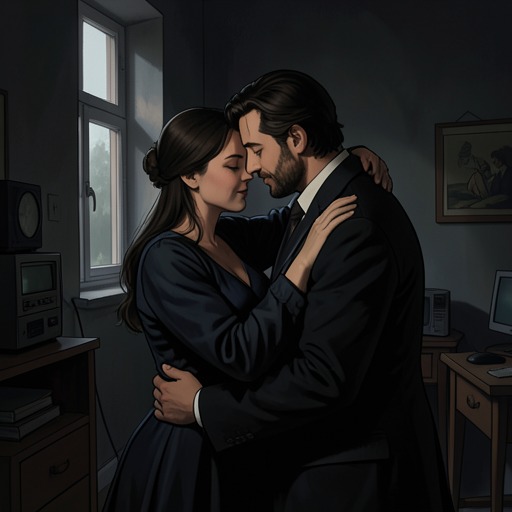
The marital relationship between Dasa and Pravati
The Glass Bead GameDasa and Pravati’s marriage is the central personal bond in Dasa’s imagined Indian life: it draws him away from the herdsmen, gives him a home and a son, and then becomes entangled with betrayal, war, and bereavement. Their story turns on the difference between the happiness Dasa builds around love and his later recognition that neither love nor its rewards can be held secure.
Marriage and the Life Dasa Chooses
Dasa meets Pravati after he has grown into a young man among the herdsmen. She is a tenant farmer’s daughter, and his attachment is strong enough to change the direction of his life. When the herdsmen move on, he rejects their advice, leaves the life he has loved, and settles among strangers in order to marry her. He works his father-in-law’s fields and helps at the mill and woodlot; he also builds a hut for Pravati. Marriage thus begins not as an addition to Dasa’s old life but as a decisive departure from it.
The new household brings happiness, but not an untroubled one. Dasa’s position as a son-in-law leaves him subject to his wife’s family, and the narrative places his delight in Pravati alongside vexations, demands, and taunts. Their intimacy offers him a refuge from those pressures, so that his joy in the marriage becomes concentrated in the relationship itself. That intensity foreshadows how devastating its disruption will be.
Betrayal, Revenge, and Reunion
When Rajah Nala comes to hunt in the countryside, Pravati disappears from the couple’s hut. Dasa searches for her, and his youngest brother-in-law eventually reveals that she is with Nala. From a hiding place near the encampment, Dasa sees Pravati welcome the prince. He experiences the discovery as a shattering loss and insult, then kills Nala with a stone from his herdsman’s sling and flees into the woods. The marriage is broken apart by an episode that makes Dasa an outlaw and sets his private grief within a larger story of revenge and political inheritance.
Later, while Dasa is living in the forest with a yogi, Pravati appears among the trees. Her costly clothes and jewelry make him pause: he wonders whether she is still connected to Nala and whether she has come wearing gifts from the man he killed. But he soon embraces her, and the return of intimacy sweeps aside his questions. Pravati tells him that Nala is dead, that the pursuit of his killer has ended, and that Dasa has been recognized as the rightful heir. An old herdsman and a Brahman have revived the story of Dasa’s expulsion, and the search that once sought him for punishment now seeks to restore him to his father’s palace. The reunion brings the couple back together at the same moment Dasa’s fortunes are transformed.
Shared Rule and Diverging Loyalties
Pravati adapts quickly to life among the nobility. She takes on the bearing and appearance of a princess, and for years she and Dasa live in harmonious love, admired by their people. Their son, Ravana, deepens Dasa’s sense of attachment to family and inheritance: possessions that once mattered chiefly as gifts for Pravati acquire new importance as the means of securing their child’s future.
Their marriage also becomes a political partnership under pressure. When conflict with neighboring rulers intensifies, Dasa hopes to make peace through mediation and territorial concessions. Pravati rejects that course. She argues that the enemy will use each concession to weaken the kingdom before attacking again, and insists that Dasa must consider his dignity, his wife, and his son. Their disagreement becomes a violent quarrel and a serious estrangement. The conflict is not merely over policy: Pravati sees the kingdom’s survival at stake, while Dasa grieves over killing, lost peace, and the abandonment of the contemplative life he once valued.
As Dasa yields to the prospect of war, the distance between them widens. He remembers that he gave up his freedom as a herdsman for Pravati, and later interprets Nala’s arrival and her departure with him as the beginning of his misfortunes. Yet his reflections complicate blame. He recognizes that Pravati is not the cause of his choices or the sole author of his suffering; he understands her as caught in the same world of ambition, desire, and violence that has overtaken him. His longing for peace and his responsibility for his own path coexist with his continuing attachment to her.
War, Loss, and the Marriage’s Final Image
The marriage reaches its bleakest point when Govinda’s forces invade Dasa’s capital while Dasa is drawn toward the frontier. He turns back to defend his family, fights through the city, and is captured after the battle is lost. Taken into the palace room where he kept his scrolls, he finds Pravati sitting with their dead son across her knees. Her hair has turned gray, and she seems numbed by grief. Dasa kneels before her and Ravana, mourning both and paying them homage, but he and Pravati exchange no words. Soldiers then lead him away.
The final image makes the collapse of their shared life visible without offering reconciliation or explanation. Once united by a love that carried Dasa from pastoral freedom into marriage, parenthood, and royal life, the couple are left together only in grief, separated by silence and the political defeat around them. The marriage’s trajectory gives concrete form to the Indian life’s governing reversal: Dasa repeatedly finds happiness, loses it, and discovers that the attachment that once seemed to make life complete cannot protect him from change.